Checklist: Coordinating quotes from multiple manufacturers
Several manufacturer quotes are comparable only when each supplier prices the same specification, quantity, quality expectations, packaging, delivery basis, and commercial assumptions. A structured quote process reduces hidden exclusions and helps the buyer separate true cost differences from scope differences. Keep clarifications and revisions connected to the offer that will become the purchase order.
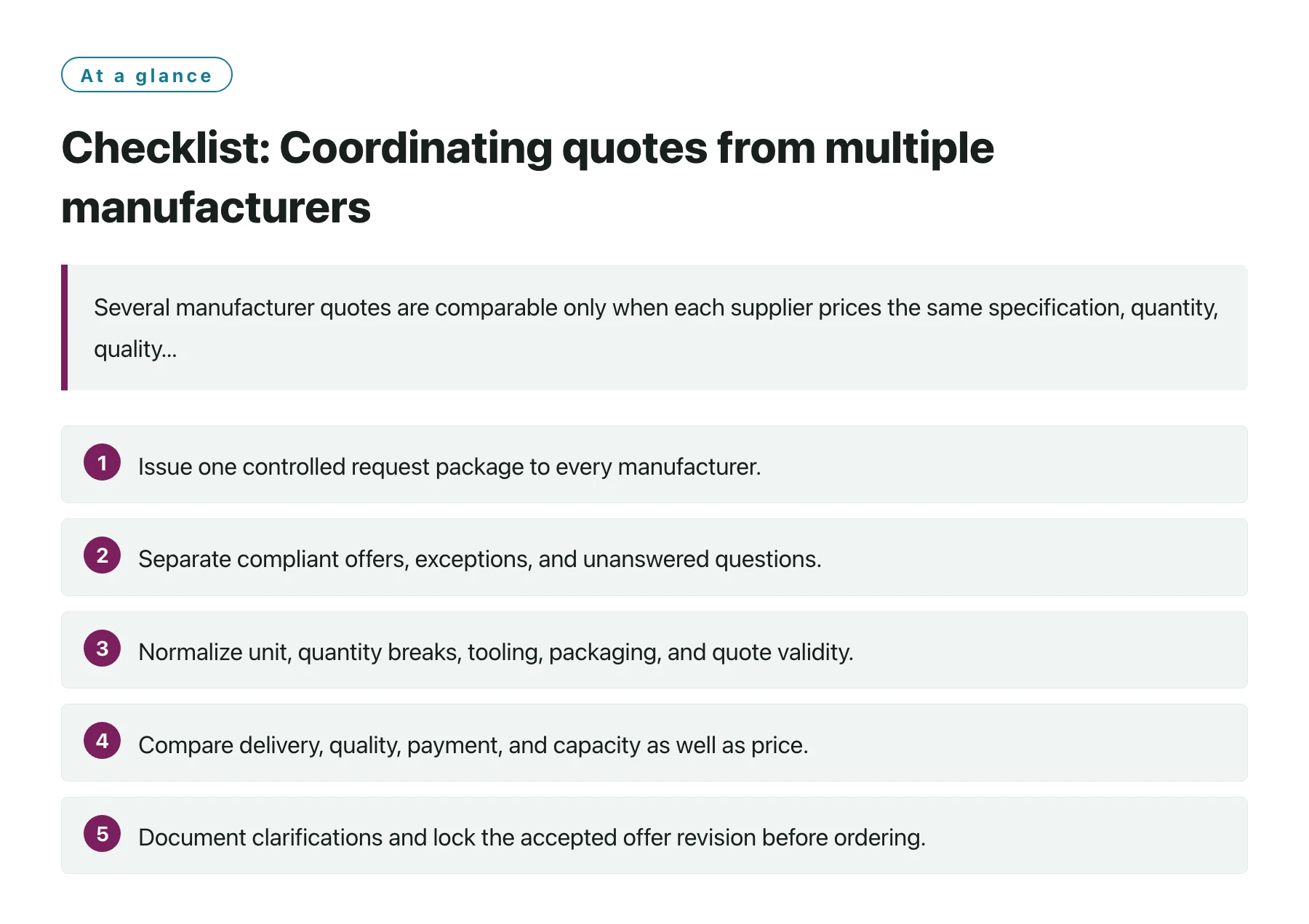
Key takeawaysIssue one controlled request package to every manufacturer. · Separate compliant offers, exceptions, and unanswered questions. · Normalize unit, quantity breaks, tooling, packaging, and quote validity. · Compare delivery, quality, payment, and capacity as well as price. · Document clarifications and lock the accepted offer revision before ordering.
A quote comparison should preserve both the number and the assumptions behind it, so procurement can explain why one offer was selected.
1. Prepare one request package
Send each manufacturer the same drawing, bill of materials, target quantity, annual forecast, packaging requirement, destination market, quality criteria, delivery window, and requested response format. Include revision identifiers and mark which requirements are mandatory. State the date by which questions must be raised.
Separate technical documents from commercial assumptions. If suppliers receive different product descriptions, an apparent price advantage may reflect a different scope. Keep a distribution log showing which files and revisions each bidder received and when.
2. Ask suppliers to confirm capability and exceptions
Require a line-by-line response: compliant, exception, alternative proposed, evidence available, or clarification needed. Ask which site will produce the goods, what processes are outsourced, and whether capacity, tooling, materials, or testing are included in the proposal.
Do not treat silence as confirmation. Resolve specification gaps before final comparison and record the agreed interpretation. If one offer depends on an unapproved alternative or a future capability claim, show that condition clearly rather than blending it into the base offer.
3. Normalize price basis and quantity breaks
Check currency, unit of measure, minimum order quantity, price tiers, lot size, order frequency, quote validity, and payment assumptions. Normalize price per usable unit or set where offers use different packaging quantities. Identify setup costs, tooling, sampling charges, and one-time engineering fees separately.
Ask whether the quote includes spare parts, accessories, labels, export cartons, pallets, or required documentation. Verify arithmetic and formula assumptions in the comparison sheet. When a supplier offers multiple tiers, compare the tier relevant to the actual purchase plan instead of selecting the lowest theoretical quantity price.
4. Reconcile tooling, samples, and packaging
Record who pays for molds, fixtures, artwork, test samples, and packaging plates; who owns them; where they are stored; and what transfer or maintenance terms apply. Separate development cost from recurring production cost. Confirm sample lead time and whether sample fees are refundable or creditable.
Compare packaging configurations, carton dimensions, units per pack, palletization, protection, markings, and labeling. A lower unit quote may require different outer packaging or leave the buyer to fund customization. Include the packaging version that will be used for production in the final offer.
5. Compare quality scope and evidence
Check what incoming, in-process, final, laboratory, and third-party inspection activities are included. Ask for sample methodology, acceptance criteria, report format, and shipment-release authority. Distinguish a supplier’s own checks from buyer witness, independent inspection, and accredited testing.
Compare evidence against the exact model, revision, factory, and destination market. If an offer excludes testing or assumes a generic certificate will be accepted, identify the resulting cost, schedule, and approval risk. Set aside offers that do not meet mandatory safety, performance, or regulatory criteria until gaps are resolved.
6. Normalize delivery and landed cost
Record the exact Incoterms® rule, version, and named place if used, plus pickup, export, freight, insurance, destination charges, customs brokerage, and final delivery assumptions. ICC rules allocate specified delivery tasks, costs, and risks when incorporated into a contract; they do not make every quoted logistics charge identical. [1]
Build a comparable total using the same shipment volume, mode, destination, and schedule. Mark freight estimates and duties separately if they are not confirmed. Include inspection travel, destination handling, and expected inventory or delay costs when these differ across offers.
7. Review capacity, lead time, and quote validity
Ask for sample time, material procurement, production duration, inspection window, packing, and dispatch milestones. Confirm capacity is available for the required period and whether lead time starts after deposit, approved sample, artwork, or another event. A single “delivery in 30 days” may hide different start points.
Compare quote expiry, raw material assumptions, exchange-rate validity, and surcharge clauses. Record what happens if quantity, specification, or timing changes. Ask each manufacturer for the earliest warning signal if a committed milestone is at risk and which alternative schedule is realistic.
8. Assess payment, warranty, and remedies
Compare deposits, balance triggers, accepted payment methods, currency, bank charges, credit terms, warranty scope, replacement conditions, and nonconformity remedies. Verify beneficiary details independently and define how changed bank instructions are authenticated. Avoid comparing cash terms with credit terms without recording the difference.
Review cancellation, late delivery, excess or shortage, defect claims, and dispute-resolution terms with appropriate advisers. Commercial clauses should be consistent with product acceptance, inspection records, and the order’s delivery basis. Identify non-negotiable risk points before selecting a preferred bidder.
9. Maintain a clarification and decision log
Use a comparison matrix with supplier, quote version, date, specification revision, normalized unit price, tooling, lead time, delivery basis, quality scope, exceptions, assumptions, and open questions. Link each clarification to the supplier’s written response and update the revision rather than overwriting earlier offers.
Score mandatory compliance separately from preferences such as responsiveness or flexibility. Document the evidence behind each score and the reason for selection. A weighted total should not allow an attractive price to cancel a critical unresolved technical or market requirement.
10. Convert the accepted quote into a controlled order
Before issuing a purchase order, confirm the selected offer version, specification, approved sample, quantity, price, payment milestones, tooling, packaging, quality plan, delivery term, named place, dates, and authorized exceptions. Attach or reference documents by revision. Ensure the supplier acknowledges the final terms in writing.
Buyers using finding Chinese manufacturers for wholesale orders can coordinate clarifications and normalized comparison fields across manufacturers. After award, close out unsuccessful bids appropriately, protect confidential information, and retain the decision record for future price and performance reviews.
Sources
Frequently asked questions
Can the lowest manufacturer quote be selected immediately?
Only after confirming scope, compliance, capacity, quality controls, delivery assumptions, and commercial terms.
How should different unit prices be compared?
Normalize currency, unit, quantity, packaging, tooling, exclusions, delivery basis, and usable yield.
What if one supplier proposes an alternative material?
Record it as an exception and obtain technical approval before comparing it as a compliant offer.
Which quote revision should the purchase order reference?
Reference the final written revision with accepted clarifications, specification versions, and all approved exceptions.