Sourcing a Fragrance OEM in China: What Your First Order Needs
Most first orders placed with an overseas fragrance manufacturer do not fail because the scent was wrong. They fail on the unglamorous parts: a sample approved against the wrong reference, a label artwork that arrives after the bottles, a missing safety document at the port. The sequence below is the one that keeps those failures visible early, while they are still cheap to fix. Treat it as a checklist rather than a theory.
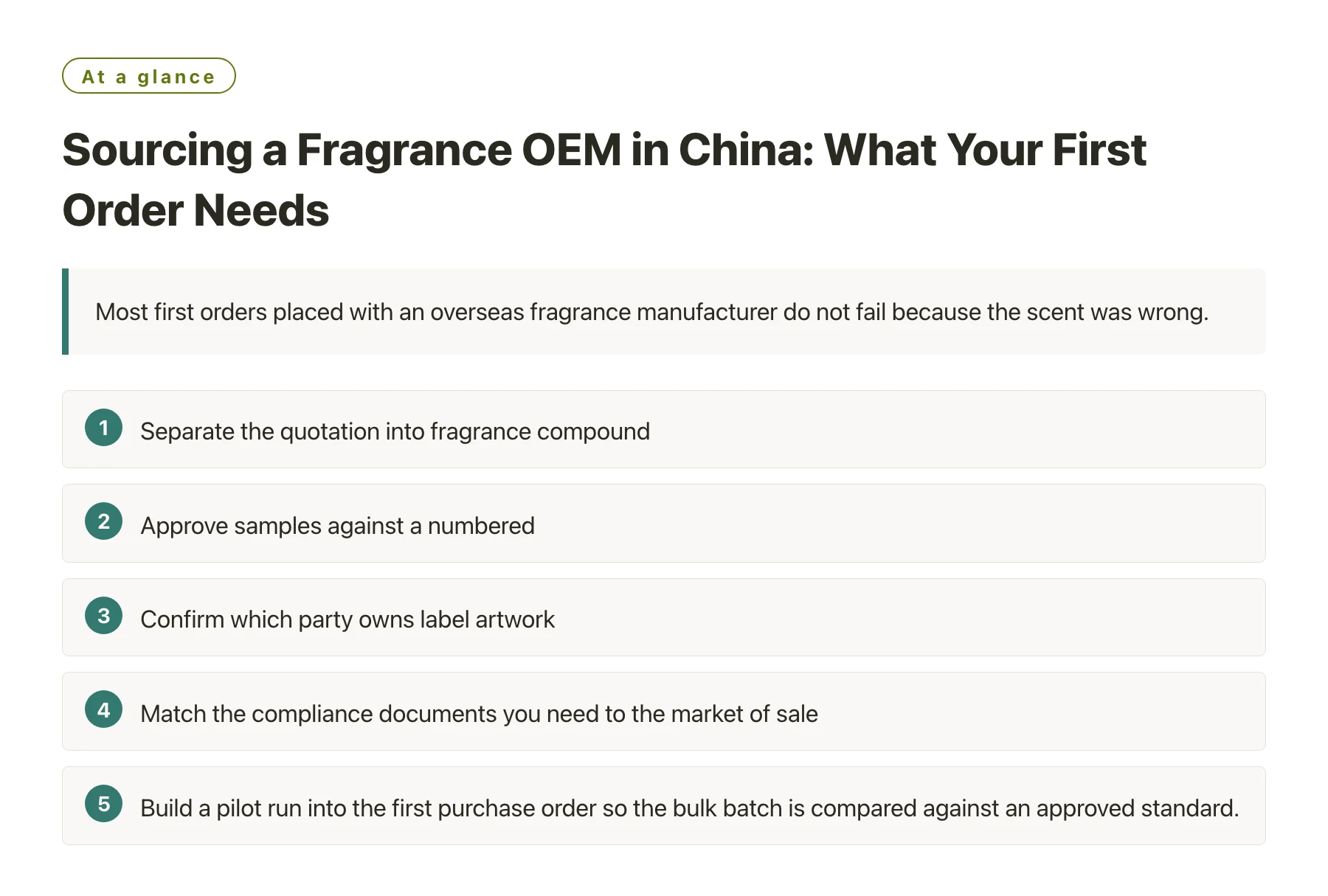
Key takeaways
- Separate the quotation into fragrance compound, filling, packaging and testing, because a single blended price hides scope differences.
- Approve samples against a numbered, dated reference that stays with the manufacturer and with you.
- Confirm which party owns label artwork, translation and regulatory review before production is scheduled.
- Match the compliance documents you need to the market of sale, not to the country of manufacture.
- Build a pilot run into the first purchase order so the bulk batch is compared against an approved standard.
Buying fragrance from a factory in another country is a project management exercise with a creative component attached. The creative part gets all the attention, and the project management part decides whether the launch date holds.
The distance makes two things harder. You cannot walk into the plant when something looks wrong, and small misunderstandings about scope do not surface in conversation the way they do across a table. Both problems are managed with written, dated records rather than with trust or with a lower price.
This article covers the sequence for a first order and the documents that tend to be discovered too late. It assumes you already have a formula you like, or a brief you are ready to place.
Before the quotation is worth comparing
Quotations from different suppliers are only comparable when they cover the same scope. That sounds obvious, and it is the single most common reason a first order goes over budget.
A quote that includes fragrance compound only, and one that includes filling, bottle, cap, carton and export testing, can differ by a wide multiple without either supplier being dishonest. Ask each one to break the number down into the same four lines before you compare totals.
Split the price into four lines
Ask for the fragrance compound cost per kilogram, the filling and assembly cost per unit, the packaging cost per unit, and the testing and documentation cost as a separate line. Once those four numbers sit side by side, differences between suppliers usually explain themselves.
The fragrance line is the one worth interrogating most, because it is where concentration and material choice hide. Two quotes at the same unit price can carry very different oil loads, and the cheaper one is often cheaper for that reason alone.
Agree what the minimum order really is
Minimum order quantities are usually set by the smallest run the filling line can handle efficiently, not by the fragrance itself. If a supplier quotes an MOQ that does not fit your launch plan, ask which component is driving it. Sometimes the answer is the bottle mould, and sometimes it is the printing setup, and the two have different solutions.
Ask this question before sampling rather than after. It is much easier to adjust a project while the formula is still being chosen.
Confirm who holds the formula and the artwork
Ownership sounds like a legal footnote and behaves like a production constraint. If the brand does not hold the formula, switching suppliers later means starting the development work again. If the brand does not hold the artwork files, every future label change becomes a request.
Put both points in writing before the order, along with the agreed reference standard for the fragrance. A one-page annexe is enough, and it prevents most of the arguments that otherwise appear months later.
A first-order sequence that keeps risk visible
- Write the brief in numbers, not adjectivesTarget market, unit cost ceiling, expected wear time and packaging format give a factory something it can actually quote against.
- Request a development sample and a reference standardAsk for the sample with a batch number, a date and a stored reference that both sides keep for comparison.
- Test the sample where it will be soldRun it on several people in the target climate, and check the dry-down at the two-hour and six-hour marks.
- Freeze the formula and the specification sheetSign off the formula, the carrier ratio, the fill volume and the packaging components in one document.
- Run a pilot before the bulk orderA small production run exposes filling, sealing and label alignment problems while volumes are still low.
- Inspect against the standard, not against memoryCompare the pilot against the retained reference; if the match is not close, stop before bulk is committed.
Documents and details that decide whether the order ships
| Item | What you should receive | Where it usually goes wrong | How to close the gap |
|---|---|---|---|
| Formula and specification sheet | Full formula reference, carrier ratio, fill volume, tolerances | Verbal agreement with no signed version | One signed annexe listing every parameter |
| Safety and compliance file | Material safety data, allergen declaration, restricted-material statement | Documents issued for the wrong market | State the country of sale before the first sample |
| Quality system evidence | Certificates for the systems the factory operates | Copies requested late, after the schedule is set | Ask during supplier qualification, not at shipping |
| Artwork and translation | Print-ready files, barcode, ingredient list, warnings | Text approved after the print run is booked | Freeze artwork before the bottle order |
| Reference standard | Retained sample with batch number and date | No retained sample kept by either side | Agree storage and retention period in writing |
The pattern in the third column is that every gap is discovered at the point where it is most expensive to fix. Moving those conversations earlier costs nothing except an email, and it is the difference between a launch that holds and one that slips a quarter.
Compliance is set by the market of sale
One of the most persistent misunderstandings in overseas sourcing is the belief that compliance is a property of the factory. It is not. Compliance is a property of the product in the market where it is sold, and the factory supplies the evidence that supports it.
That distinction decides which questions to ask and when.
Fragrance safety limits travel with the formula
The International Fragrance Association publishes standards that restrict how much of a given material may be used and in which product categories [1]. A formula built to those limits is easier to place in multiple markets, so it is worth asking early which materials in your formula carry restrictions and how much headroom remains.
If the answer is that a key material is close to its limit, the formula is fragile: a small change in concentration or a new market entry may force a reformulation.
Third-party testing is evidence, not a substitute for a system
Laboratory testing services such as those offered by SGS cover cosmetics, personal care and household products, and can provide the reports that customs and retailers ask for [2]. What testing cannot do is replace a functioning quality system inside the plant, which is why the two are requested together.
Ask which certificates the factory holds and which reports are issued per batch. The second list is the one that matters at shipment, because it is specific to your order.
Know the rules of the destination market
If you sell in the European Union, the product needs a responsible person established there, a compliant ingredient list and a safety assessment, all of which are set out in the Commission's public guidance on cosmetics [3]. Buyers who learn this after the first order often have to re-label and, in some markets, re-notify.
Buyers who compare quotes from an OEM perfume manufacturer in China with those from a domestic blender are usually comparing two different scopes rather than two prices. A manufacturer used to export work will include the documentation in its process because it has to.
The costliest habit in first-order sourcing is treating the sample approval as the end of the technical work. It is the beginning of it. The approved sample becomes the reference standard that the bulk batch is judged against, and if nobody kept it, nobody can prove whether the bulk is right. Before you send the purchase order, confirm three things in writing: the retained reference and where it is stored, the specification sheet with tolerances, and the list of documents that will accompany the shipment. Factories such as Xuelei that handle export orders routinely will have a standard version of this list; your job is to check that it matches the market you are actually selling into.
Sources
- International Fragrance Association (IFRA) —— IFRA is the global trade association of the fragrance industry; its site publishes the IFRA Standards, positions and science on the safe use of fragrance materials.
- SGS: Cosmetics, Personal Care & Household Testing —— Testing, inspection and certification services for cosmetics and personal care, including microbiological, stability and safety testing aligned with cosmetics GMP.
- European Commission: Cosmetics in the EU —— The European Commission's overview of EU cosmetics rules, including the responsible person, product information file and safety report requirements.
Frequently asked questions
How do I compare quotations from perfume factories fairly?
Ask every supplier to break the price into fragrance compound, filling and assembly, packaging, and testing and documentation. Compare the four lines rather than the totals. Most apparent price differences disappear once you can see which scope each quote includes and which it quietly excludes.
What minimum order quantity should I expect for a first fragrance order?
It depends on which component sets the floor. Bottle moulds and printing setups often drive the minimum rather than the filling line or the fragrance itself. Ask the supplier which item is setting the MOQ, because that answer usually reveals where the cost can be reduced.
Do I own the fragrance formula if a factory develops it for me?
Only if the contract says so. Ownership should be agreed in writing before development starts, together with the artwork files and any moulds. Without that, changing suppliers later can mean repeating the entire development process from the brief.
Which certificates should a fragrance manufacturer hold?
For cosmetics-grade production, the relevant systems include cosmetic good manufacturing practice such as ISO 22716, along with quality and environmental management systems. Ask for the certificates and for the batch-level reports that apply to your order, since the two serve different purposes.
Why did my bulk order smell different from the sample I approved?
The usual causes are insufficient resting time before filling, a different carrier ratio in the bulk batch, or storage in a poorly sealed container. Comparing the bulk against the retained reference standard, and asking for the resting period in writing, resolves most of these cases quickly.